
BY JAMESON DAINES · BEHAVIOR-CENTERED DESIGN
The shared canvas for behavior-centered product teams.
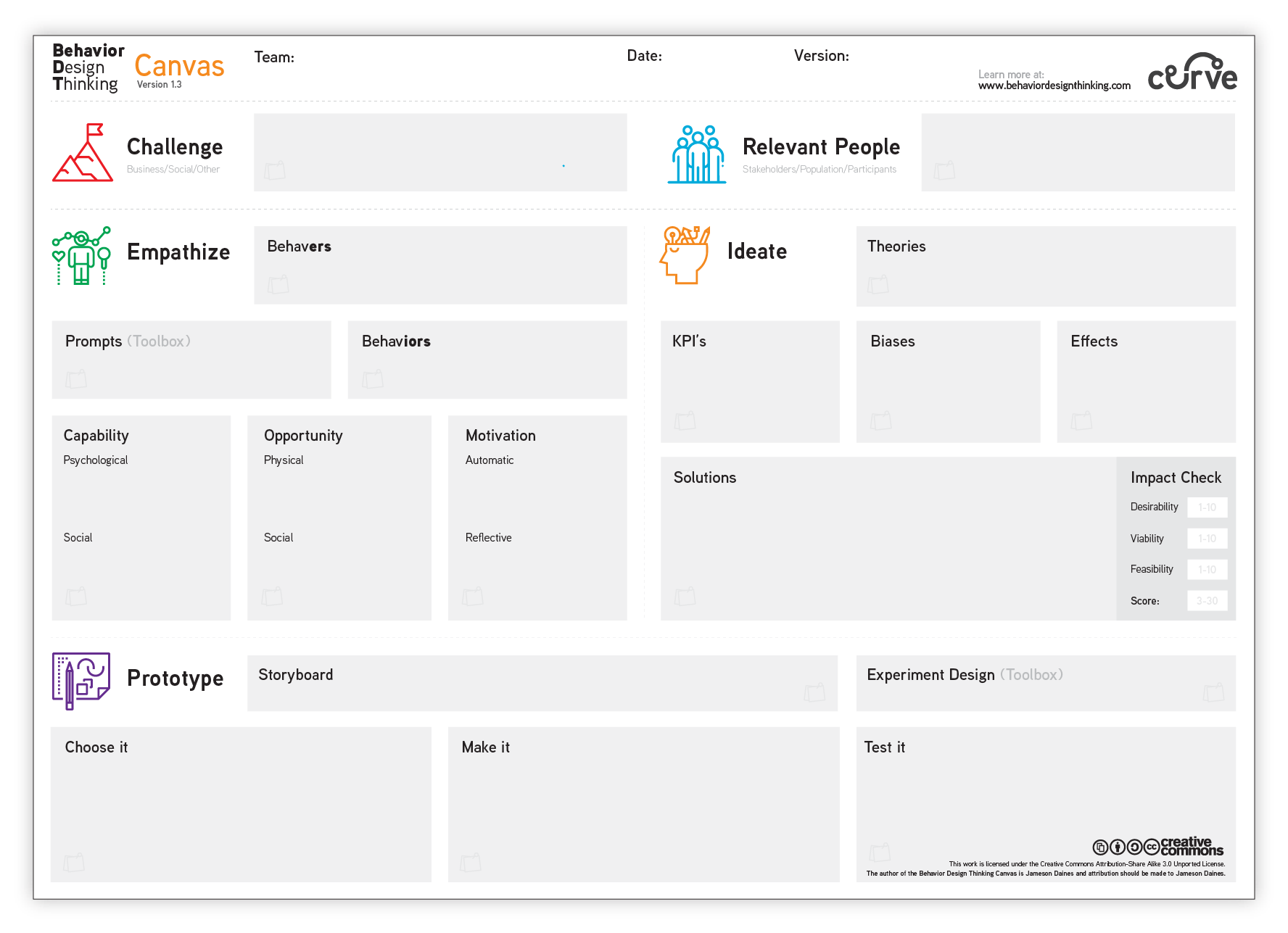
Behavior-centered design puts behavioral science on the whiteboard next to everything else a product team argues about. The BehaviorUX Canvas is the one-page tool I use with health-tech teams to turn psychology research into product decisions they can actually ship.
Downloaded by individuals at

WHY THIS EXISTS
Design thinking has a blind spot.
Classic design thinking gives you a creative process, but it stops short of explaining why users do what they do. You can nail the workshop, ship the prototype, and still watch adoption fall off a cliff in week two because nobody on the team accounted for the psychology.
The BehaviorUX Canvas puts the psychology back in. Every phase borrows from published behavior-change research, so the ideas you walk out with have a reason to work, not just a reason to look good on the whiteboard.
The 5 canvas zones
Challenge
People
Empathize
Ideate
Prototype
THE BEHAVIOR TOOLBOX
30+ cognitive biases and behavioral theories, ready to pull off the shelf
The canvas ships with a companion toolbox, a plain-language reference of the behavioral science principles I keep reaching for in real projects.
Each principle lives next to the phase it belongs in, so when you hit the moment you need it, you don’t have to go looking.
Empathize Prompts
COM-B Model (Capability, Opportunity, Motivation)
Knowledge & Skills Assessment
Social Influences & Identity
Environmental Context & Resources
Beliefs about Consequences
Memory, Attention & Decision Processes
Ideate Theories & Biases
Loss Aversion
Hyperbolic Discounting
Default Bias & Status Quo
Self-Signaling & Identity
Goal Gradient Theory
Theory of Planned Behavior
HOW IT WORKS
Three phases. One canvas.
Empathize
Think about your audience as “behavers,” not users. What can they actually do? What does their environment let them do? What are they motivated to do? The COM-B model gives you a way to answer those questions on paper.
Behavers / Prompts / Behaviors / COM-B Analysis
Ideate
Use published behavior-change theories and the biases the toolbox lists to generate ideas with some science behind them. Then score each one on desirability, viability, and feasibility so you know which ones to prototype first.
Theories / KPIs / Biases / Effects / Impact Check
Prototype
Storyboard the intervention, design a simple experiment to test it, and run it through the choose-make-test loop until you’ve got something worth showing to real users.
Storyboard / Experiment Design / Choose / Make / Test
INSIGHTS
Thinking
BEHAVIOR CHANGE
Why health-tech products lose users after week two
FRAMEWORKS
Design thinking is incomplete without behavioral science
METHODOLOGY
How to use the COM-B model in product design
Start designing for behavior change.
Grab the canvas and the companion toolbox. Both are free and Creative Commons, so do what you want with them.